Underground
Waterproofing for foundations
Liquid exterior sealing for underground structures, combined with detail repair and mechanical protection before backfilling.
Per projectCovered, positive water pressure
PolyShield performs this
Waterproofing for foundations
Waterproofing for foundations as a complete waterproofing route for basement exterior walls and foundations.
- Inspect roof structure, moisture and details
- Cleaning and repairing weak areas
- Apply primer and detail reinforcement
- Waterproof membrane delivered in a controlled manner
From damage picture to solution
Problem, cause and effect first visible.
- UV and weather loads
- Movement of seams and connections
- Overdue maintenance or previous emergency repairs
Moisture can damage insulation, interior, installations and business processes.
Een renovatie afgestemd op het gebouw van ondergrond, details, primer en doorlopend membraan.
Business benefits
The value is not just in the new layer.
Lifespan
Maintain a technically suitable roof structure and postpone replacement.
Continuity
Organize renovation per work area around the use of the building.
Risk management
Include critical details before consequential damage occurs.
Maintenance
Een inspecteerbare en lokaal herstelbare aanpak creëren.
RISK OF DELAY
Delay can allow local defects to progress to wet insulation, larger repair zones and damage under the roof.
First have the size, cause, accessibility and desired planning assessed. We then compare repair, renovation and, where necessary, replacement without selling a standard solution in advance.
Have project assessed →System construction
A complete structure, no loose coating.
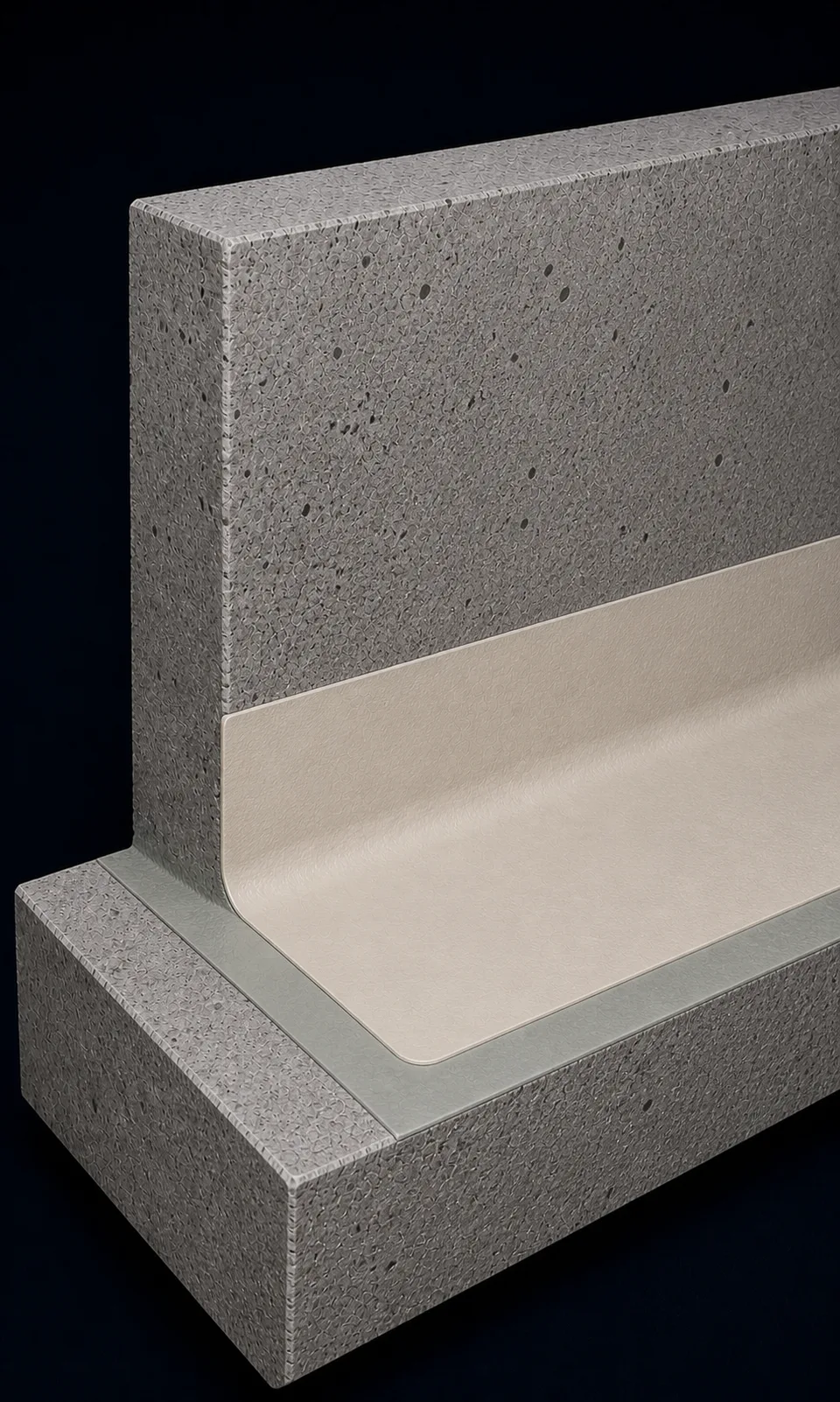
De visual maakt het functionele principe inzichtelijk. Exacte producten, laagdiktes en verbruiken volgen uit ondergrondonderzoek en de projectspecificatie.
- 01Construction wall
Restored and sufficiently flat
- 02Primer
Adhesion and pore control
- 03Waterproof membrane
Continuous outer seal
- 04Protective layer
Protection during backfilling and drainage
System profile
What this direction is rated for.
- Basement exterior walls
- Foundations
- Underground technical rooms
- Positive water side
- Seamless
- Complex details
- Covered application
- Concrete
- Masonry
Application boundaries
Where this system fits primarily, conditionally or non-standard.
The classification helps with the initial selection. Substrate, load, detailing and current system documentation remain decisive.
Other building parts only after additional validation.
- Wet or unstable surface
- Unknown layers without test adhesion
- Structural defect without repair
- Undocumented product combination
Beoordeling in de praktijk
Wanneer funderingen kansrijk is
Liquid exterior sealing for underground structures, combined with detail repair and mechanical protection before backfilling.
Wanneer dit meestal past
Basement exterior walls
De ondergrond en detaillering moeten deze systeemroute aantoonbaar toelaten.
Foundations
De ondergrond en detaillering moeten deze systeemroute aantoonbaar toelaten.
Underground technical rooms
De ondergrond en detaillering moeten deze systeemroute aantoonbaar toelaten.
Wat we eerst willen weten
- Water pressure
- Cracks and pour seams
- Implement
- Floor-wall connection
- Soil and drainage
Wanneer we een andere aanpak adviseren
Constructieve scheuren apart behandelen Beschermen tegen aanvulschade Negatieve zijde vraagt andere beoordeling
01 / Inspect
We want to know this first.
- Water pressure
- Cracks and pour seams
- Implement
- Floor-wall connection
- Soil and drainage
02 / Limit
When we don't execute immediately.
- Treat structural cracks separately
- Protect against filling damage
- Negative side requires different assessment
03 / Substantiate
Which must be demonstrable.
- Suitability for permanent moisture load
- Detailed plan
- Check before covering
Technical proof
Performance is system and structure specific.
The statuses below are deliberately reserved. A proof is only shown as proven after the current document, the system variant and the intended use have been checked.
ETA/EAD
An ETA applies to the described system kit and its intended use. Document number and current system variant are checked before publication.
CE and declaration of performance
CE and DoP describe declared product performance; they are not a blanket endorsement of every roofing project.
BROOF classification
Only claimable for the exact tested roof structure, substrate, layer thickness and the stated test suffix, for example BROOF(t1).
Waterproofing
Test performance and application conditions must correspond to the selected membrane variant and project structure.
Crack bridging and movement
Class, temperature and layer thickness are taken from the current technical documentation.
VOC and environmental documentation
VOC, EPD and other environmental claims are only published with a current, traceable source.
Van mogelijke oplossing naar aanbieding
Four pieces of information that really determine the quotation.
Material, condition, moisture, adhesion and existing layers.
Edges, bilges, drains, penetrations, seams and connections.
Water, UV, movement, traffic, use and operating conditions.
Accessibility, phasing, safety, planning and weather window.
Frequently asked questions
Technical clarity before application.
Is this system directly suitable for every surface mentioned?
No. The substrate must fall within the approved system scope and is checked for cohesion, moisture, contamination, movement and adhesion. The correct preparation and primer are then recorded.
Is the layer structure shown always the same?
The functions remain recognizable, but primer, reinforcement, number of layers and consumption may differ per substrate and load. The final structure is stated in the project specification.
Can the system be installed over existing waterproofing?
Only when material, mounting and condition are known and a compatible structure can be demonstrated. For unknown membranes or coatings, we first carry out identification and test adhesion.
What lifespan or warranty applies?
Technical ratings and expected useful lives are for specifically rated systems. The project guarantee also depends on the surface, scope, implementation, maintenance and written agreements.
What is the first step?
A project screening and inspection. We record construction, surface, damage picture, water load, details, accessibility and desired planning.
Related expertise
From waterproofing system to application, evidence and project route.
These next steps are linked to application, substrate, risk and decision phase. This way you navigate from general information to technology, evidence and a useful project route.
Knowledge
Why use primer for roof coating?
Primer selection depends on the surface, preparation, moisture and adhesion route.
View this route →TechnologyPrimers and adhesive layers
De voor het betreffende project verbinding tussen voorbereide ondergrond en vervolglagen.
View this route →TechnologyPremium cold applied 2K polyurea
Complete quick waterproofing route with primer, details and UV resistant membrane.
View this route →SolutionActively stop leakage in a targeted manner
From leakage route and water pressure to injection, detail repair and follow-up protection.
View this route →ApplicationPolyShield Joints
Controlled sealing of moving, water-laden and industrially stressed joints.
View this route →HulpmiddelGebouwen vergelijken
Rangschik meerdere gebouwen op urgentie, gevolgschade, bedrijfsvoering en beschikbare informatie.
View this route →